


Author Patricia Cornwell and showrunner Liz Sarnoff discuss finally bringing the “quiet storm” that is forensic pathologist Kay Scarpetta to the screen
The fact that forensic pathologist Kay Scarpetta, lead character in Patricia Cornwell’s bestselling book series, didn’t make it to film or TV before now was never for lack of trying. “The Scarpetta series has been snapped up by [movie studio] options ever since 1989,” says Cornwell. “But every attempt at bringing her to the big screen failed — and it always failed in the writing stage. Nobody was able to figure out how to adapt these stories and make them visual.” Then Liz Sarnoff entered Cornwell’s life. A writer on shows like Barry, Deadwood and Lost, she was a huge fan of the novels and convinced the author that she would be their best steward. “I think she knows some of the books better than I do, to be honest,” Cornwell muses. “She got the spirit of it, she understood the characters and then she figured out the way to do it — because it all starts with the page.”
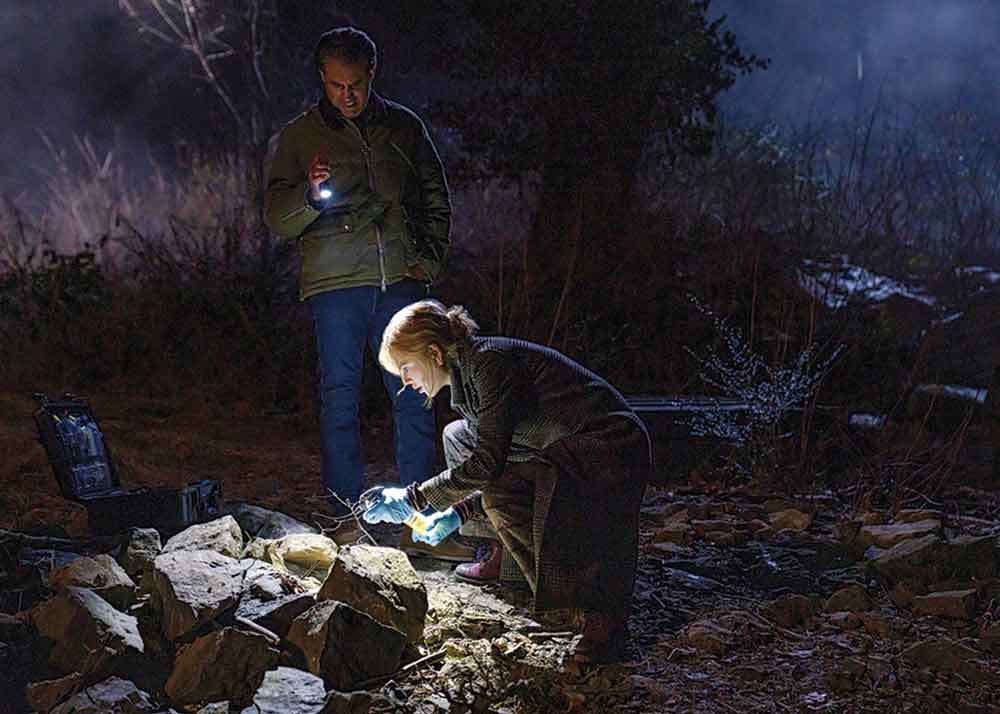
To play this brilliant and beautiful investigator, the two knew exactly who to approach. “It was always Nicole for us,” says Sarnoff, who had brought the project up to Kidman’s producing partner Per Saari. “He said, ‘Nicole has always wanted to play Kay Scarpetta. Please let us know when the script is done.’ We did, and from that moment forward it was always Nicole.” The Oscar winner lends credibility to any project, but the quality that makes her most Scarpetta-like to Sarnoff is that she feels believable as a mystery solver. “Nicole’s an incredible combination of emotional and cerebral,” the showrunner explains. “She’s a thinker, and it’s fun to watch her think. That is the perfect attribute for Scarpetta — I like watching her just look at the body and think. And you can see everything. It’s all in her eyes.”
Combining two books, Postmortem and Autopsy, is how Sarnoff felt the television series should be kicked off. This first season takes place in two timelines, one in the late 1990s where a young Kay Scarpetta investigates a serial killer strangling women in Alexandria, Virginia, and the second in the present where Scarpetta returns to her old post and begins to suspect that the very killer they caught in the ’90s may not have been their guy. “Postmortem is a fabulous introduction of the world and all the characters. I knew we couldn’t do any better than that,” says Sarnoff. “In the past, she’s arriving at a place to do something for the very first time. She’s the first female medical examiner of the Commonwealth, and that’s overwhelming. And in the present, it’s more about, ‘I can have it all. I can be a wife and an aunt to my niece and a sister, and we can all live in the same house and I’m going to go back to this job where everyone hated me and it’s all going to be great.’ And then by the end, it’s not.”

The two timelines also meant casting two versions of each character, with Rosy McEwen playing Scarpetta in her up-and-comer days. “Rosy bears such an incredible resemblance to Nicole, but beyond that is just such a wonderful actress,” says Sarnoff. “The two of them worked together and separately, and they created this character where I feel like, when we transition between them, it’s pretty seamless.” To Cornwell, these actors were the perfect combination tag team. “They’re what I call a quiet storm,” she says. “For 36 years now, people have thought that Scarpetta is like me. And I’ve tried to tell them, no, she’s not. I am not a quiet storm. I’m a stormy storm. But they really are how I envision Scarpetta. She’s cool, she’s deliberate, but oh boy, when you wind her up, you better watch out.”
The dual casting allows for other fun duos, like Kay’s sister Dorothy being played by Jamie Lee Curtis in the present and The Mentalist’s Amanda Righetti in the past. Righetti’s former Mentalist co-star Simon Baker plays FBI profiler Benton Wesley in the present, and Weeds’ Hunter Parrish portrays Wesley in the past. But perhaps the most ingenious casting is Bobby Cannavale and his son Jake as Scarpetta’s right-hand man, Det. Pete Marino. “The show is an embarrassment of riches,” says Sarnoff. “We were really able to find so many wonderful people to play all the parts and then double them. I think we were very fortunate in how we went about it. We didn’t open it up to a million auditions. [Series director] David Gordon Green and myself had a specific idea of who we wanted, even down to the smallest role.”
And indeed, what separates book from TV show is the exploration of key players other than Scarpetta. “You really see the unfolding of these characters in a way that you don’t in my books. You see what Benton’s childhood was like,” raves Cornwell. “I didn’t write much about the things that you’re going to see, because it didn’t fit with what I was doing, but it doesn’t mean that there aren’t backstories and other rooms and other voices.” For the author, there were few things she found non-negotiable in terms of the adaptation. “Liz knows the character so well that she can dance close to the lines and add all kinds of fun things without going over it,” says Cornwell. “That’s what makes the difference. If you know who somebody is, then you could play all kinds of fun things and keep them in character. But I wouldn’t want anybody turning them into characters that are not likable or admirable. With all their flaws, they’re still just wonderful characters.”
For Sarnoff, Scarpetta is the epitome of admirable. “Kay Scarpetta was a huge character for both myself and my mother at the time, because there weren’t women running around being the boss of anything then,” she says. “To have this female boss, who was very true to herself as a woman and as a human being, was really appealing. She had a rich life. She loved deeply. She cared about everything. And she had this sense of justice that couldn’t be moved. I loved her. I thought she was amazing. And I loved that she was able to speak her truth, not worry about the consequences so much and do what she thought was right. I thought, ‘That would be an amazing thing to be able to bring to life.’”
The sheer propulsion one feels while reading a Scarpetta novel is something Sarnoff also wanted to bring to the screen. “I think something that I learned on Barry was to try to get as much as possible into the episodes — background, foreground . . . everywhere, something is happening and multiple things are happening at the same time,” says Sarnoff. “We’re telling the story of two murder mysteries and two books over eight episodes. You got to keep moving.” In the end, even Cornwell couldn’t help but be impressed. “I’ve marvelled over these ideas that the writers come up with,” she says. “It’s really rather humbling because you realize that sometimes people have ideas that work better than some of yours did. And that’s the case here. Some of what they’ve come up with, I think is just magical.”
Scarpetta, streaming on Prime Video