


Now in the midst of season three, the cast of our home and native land’s resident Law & Order spinoff tells TV Week about shining a light on hidden injustices, and infusing an iconic U.S. franchise with a Canadian identity — warts and all
To watch Law & Order is like coming home. The franchise, which notoriously details crimes pulled from the headlines, is known to evoke familiarity in its viewers, making them feel like there is justice in this world. In that sense, Law & Order Toronto: Criminal Intent is no different. “The strangest thing is when people, especially women, say that they find Law & Order comforting, because it can be so gruesome,” says Hamilton-born star Kathleen Munroe — who plays Detective Sergeant Frankie Bateman, partner to Aden Young’s DS Henry Graff. “But I think the format is familiar enough that we know we can sink into something that’s going to grip us in the same ways that we’ve been gripped before.”
What makes the Canadian iteration of the franchise stand out, though, is the talent assembled for the task. “We get the tremendous benefit of having [Rookie Blue co-creator] Tassie Cameron lead our writing room,” says Munroe. “And our amazing writers, directors and cast get to play within that format. So, rather than it feeling familiar in a way that feels stale, we get to have the format but also delve a little bit deeper and take some turns.”
TV Week sat down with the ensemble of the homegrown procedural to discuss what makes their twist on L&O ring so true.
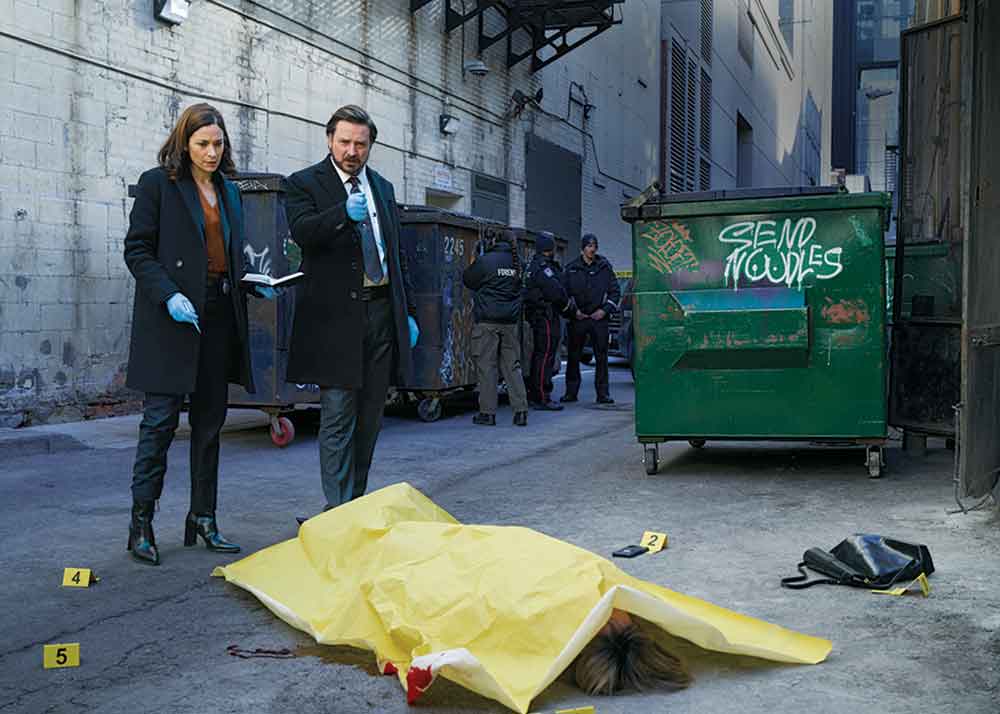
What do you feel is distinctly Canadian about Law & Order Toronto?
Nicola Correia-DamuDe (Dr. Lucy Da Silva): As Canadians, we consume a lot of media that comes from other countries, and sometimes we forget the way the Canadian system works. The way our justice system works, the way our constitution reads — there are really important and interesting differences. I think they make the storytelling very unique. Our focus as a country, in terms of what our values are and how our system reflects that, there’s a deeply Canadian difference in that. We see that reflected in the show. We recognize the system, we recognize the values, and whether we know it or not, we feel it in our everyday lives as well.
I remember, two years ago, joking that this would be Law & Order: Petty Theft, because everyone has an image of Canada being so safe and kind. What’s been interesting about delving into the crimes that do take place in this country?
MUNROE: We like to promote our values really loudly, really publicly. There’s something wrapped up in our national identity, the way that we promote ourselves as Canadians, that is rooted in an aspirational value. Sometimes this value operates in practice. Often it doesn’t.
CORREIA-DAMUDE: I think people in other countries are shocked to discover that we have real crime here. There’s a tendency to be like, “Oh, we’re so great. Canada’s so nice and peaceful.” But the reality is we have incredible racism, as well. We have crime. We have organized crime. It might look different and it might not be at the level that you find [elsewhere], but I think it’s important to remember that we have all those things here too.
KAREN ROBINSON (Inspector Vivienne Holness): Yeah. We are just as good and just as reprehensible as everybody else. We truly are. Just because we have universal healthcare — for now — does not mean that people won’t take advantage of who and what they can.

Were there any episodes or storylines, either in seasons past or the one coming up, that you found particularly interesting and illuminating from a cultural standpoint?
CORREIA-DAMUDE: I don’t know how much I can say without spoiling it, but these are real stories. Our healthcare in particular, we tend to pat ourselves on the back for — often with good reason — but there’s an episode [in season three] where we look at some of the real crimes inside our healthcare system, how something that we pride ourselves on also has these incredible injustices that have to do with race and poverty. So, I thought it was interesting to show this thing that’s so Canadian, this idea of universal healthcare and how fair everything is, and how, inside that system, there are a lot of very insidious issues happening as well.
ROBINSON: For me, it was the bread episode in season one. I love grocery shopping, and when it came out that consumers were being scammed on something as basic as bread, I was so incensed at the time. And then life goes on and the headlines change and you think about it less and less — and then it shows up in season one. And I felt that same injection of absolute rage when it was dramatized — how insidious and how systematic it was, the planning that went into making sure that people, even amongst the poorest of us, simply paid more for bread.
MUNROE: There are ways that we handle sexual assault in the show that take a little bit of a different lens. I’m thinking of the finale of season two — how even doing things right doesn’t always mean justice is served the way that we hope it would be. In the first episode of the third season, deciding not to report is also something that we investigate with a lot of empathy and understanding. We want to find the human stuff, while also trying to find the ways to still be gripping and entertaining and not exploitative, but to give some space to the other side of some of these conversations.
ARAYA MENGESHA (Mark Yohannes): There’s also the conversation of immigration. Last season, you saw these students coming here with the promise of a higher education and then being swindled. As Karen said, we can be just as great or terrible as anybody else, but one of the things we pride ourselves is on immigration and the diversity of this place. And with any of those promises comes an opportunity for somebody to take advantage, especially in the communities that were highlighted last season. We see people being attacked for being here, for following those dreams, trying to find a better life and then being faced with the consequences of just existing in a place because there’s now too many of you. The opportunity this show provides is that we can touch on these things without having to get caught in the back-and-forth of the debates.
There’s an adage that the heavy lifting is done by the guest stars, but as a regular what is the challenge of a procedural? What draws you to this material and how do you keep it fresh?
CORREIA-DAMUDE: One of the interesting things about acting in a procedural is that you get less information about your character from the scripts than you would in other kinds of storytelling. You’re creating a character and then information comes out in these little bits. So, in some ways, the writing team and the actors, we’re all learning about these characters as we go. We create someone, but then we find out more and more about ourselves in a longer arc, which I think is challenging. But it’s also what draws people to shows like this — because there’s something so satisfying about getting these little nuggets of information about characters you’re already attached to.
MUNROE: The convention of procedurals is you get to know these people through their jobs and how they respond to details in their jobs. But inevitably, with more time, you get to see more shades.
I definitely have a lot of Bateman secrets and textures and things that I want in scenes that aren’t the things that are associated with the case. And finding the ways to vary within the format, depending on how different cases touch on the human specifics in each of us, I find so much fun. Underneath is the human stuff that maybe isn’t set on the surface. And I’ll say, having now done three seasons with this group — especially the third season — there are moments where I as an actor have gone, “Oh my God,” seeing something crack a little bit in a moment where we get to discover a little bit more. The development that we get to see in the whole cast this season is one of the things that I am the most excited about.
K.C. COLLINS (Deputy Crown Attorney Theo Forrester): For me specifically, I truly appreciate that I get to learn so many new things. That really helps make the show and the experience so much more enjoyable. With something that is procedural, you would think that it’s so boring, but there’s just something amazing about being able to always continue to learn and grow. And that’s not just with the material, but it’s with your castmates as well.
ROBINSON: Listen, we get to be in something that begins with Law & Order. I have spent three seasons with these wonderful people and I still have to shake my head every now and again. So, you ask what draws us to this material? We have an amazing writing room and the stories are compelling and we can relate to them because many of them we actually read about in real time. There is all of that, but Lord have mercy, we get to be Law & Order! And that to me is unmatched.
Law & Order Toronto: Criminal Intent airs Thursdays on City