


A scientist’s stagnant relationship with his wife is jolted when he shrinks her to the size of a teacup in The Miniature Wife
Anyone in a long relationship can relate to its challenges. In the case of scientist Les Littlejohn (Matthew McFadyen) and his wife Lindy (Elizabeth Banks), it has resulted in the couple leading two separate lives. Although they once had a pact to take turns supporting each other, neither now feels taken care of, which in the case of these two has led to loud resentment. “Even though they’re doing couples therapy and making grand gestures, it’s all very empty,” says Banks, whose character feels it is her turn to focus on her career as an author. “They’re actually avoiding having any real deep conversation about what’s going on with them. And the moment they actually go at each other, say the things they’re not supposed to say and cross all the lines, he shrinks her.”
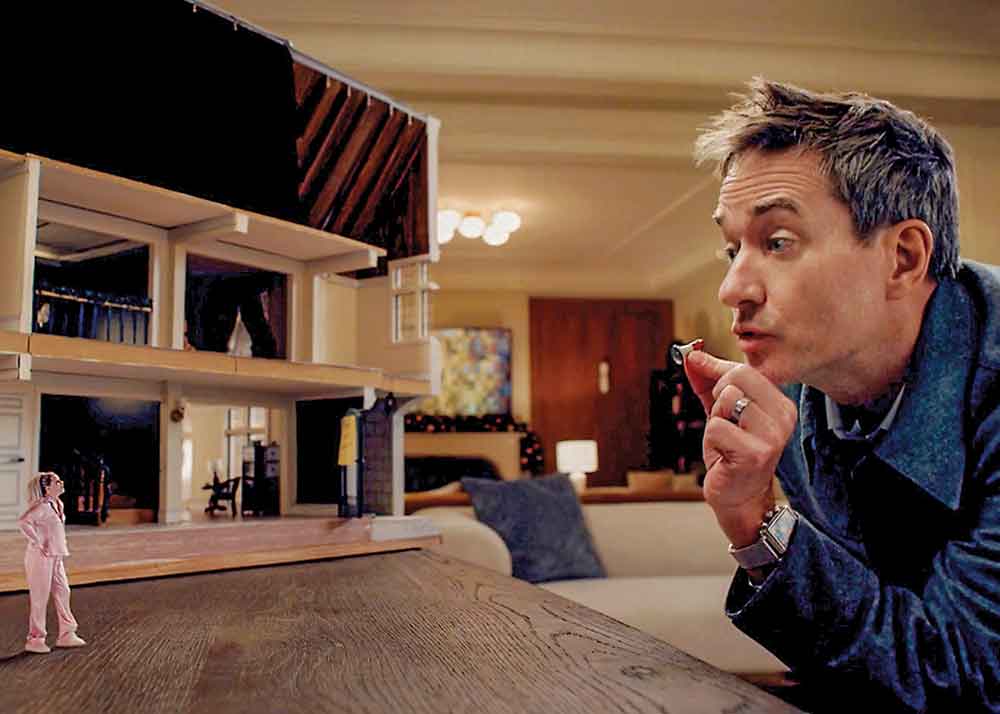
The shrinking part is no metaphor. In fact, when Banks and McFadyen signed on to play Lindy and Les, the assumption was that the two heavyweight actors would get to play opposite each other. But — as the title The Miniature Wife suggests once scientist Les literally shrinks his Pulitzer Prize-winning wife to the size of a coffee cup, the two are on their individual journeys. “We were unprepared for how little we would see each other,” admits Banks. “We thought we’d be together more. But I think it’s enriching in that the themes then become about that sense of isolation from each other, which is where they are as characters. One of the cool things about the show is that it’s told in many layers. There’s high-stakes, absurd comedy happening where she is little and he is big, but then there are great reminders from the past about what you’re rooting for.”

The physical separation between the two leads is on brand with the themes of the series, based on Manuel Gonzales’ short story from 2013. “Funnily enough, Manuel Gonzales’ short story is told entirely from Les’ point of view,” says Banks. “It really was just the jumping off point of the exploration of a relationship when you feel isolated from someone and then you actually isolate them.” When we first meet Les and Lindy, the two of them being equal in size does not translate to closeness, in fact, far from it. “They’ve gotten lost from each other, which happens in relationships,” says McFadyen. “They’ve been married for 20 years, and they both feel resentful. Both of them are at a loss as to how to get back and how to reconnect. It’s easier to avoid it.”
When screenwriter duo Jennifer Ames and Steve Turner read the short story, they felt it was ripe for potential. “In the short story, which is very dark, the wife does not have a name. He knows nothing about her, so for us, it was very exciting because it gave us the scaffolding,” says Ames. “We were able to create so much of it, which was very appealing to us.” It was when the two started imagining the experience from Lindy’s perspective that the series really took shape. “That’s when the metaphor became real,” says Turner. “She felt so small in this relationship, and then literally she’s six inches tall. It immediately jumped off the page as War of the Roses meets The Incredible Shrinking Woman — those big ’80s, ’90s comedies that we loved. And then the story plays out in this lovely way that you don’t expect, it almost becomes heartbreaking.”
For the writers, there was one aspect of the source material that had to fundamentally change for the material to work as a series with a potential second season. “It gets a little dicey between these two, but we really wanted to make sure that you were rooting for the couple and that you do love Les and Lindy,” says Ames. “Whether you side with Les or Lindy is totally up to you, and you can change teams throughout. But we really wanted to make sure there was something more optimistic about it and fun.” The levity of the show comes from absurd moments in the lab where Les struggles to find an antidote as well as from Lindy’s struggle in a giant world. “When you’re telling this kind of an extreme story, the absurdity allows the audience to relax a little bit,” says Turner. “Once they relax, that’s when you can really hit them with the drama.”
There was no question that the show needed two heavy hitters to go from ridiculous comedy to heartbreaking drama. “What Elizabeth does so well about this is that as confident as Lindy is, she’s insecure,” says Ames. “Just walking that line, I think Elizabeth has embraced and elevated the character and made it her own in such a way that I really feel all of that resonates. Elizabeth herself is a force and we’re literally knocking her down to six inches tall. I think her ability to remain strong and vulnerable in those moments, that, to me, is like a chef’s kiss.” When Ames say they knocked Banks around, that is no metaphor either. “Elizabeth did a lot of those stunts. She was on wires and jumping around. I mean, she did everything,” says Turner. “And on the other side, I think on paper, Les could be a real jerk. He shrinks his wife! I mean, how do you buy that back? The only way you buy that back is if you have somebody who has the layers of humility and humanity inside them. That’s why you get Matthew to do this.”
In the case of the TV adaptation, a big selling point is the pure fun of the series, from the legitimately insane supporting characters to a miniature world built to scale for Banks to play in. “Our goal was to really make as many giant props as we could because that’s the way for her to really feel grounded in this story,” says Turner. “The more grounded she felt, the better the scenes were. So, we did everything under the sun we could to make her feel tiny, and I think it worked.”
The Miniature Wife, streaming from Thursday, May 14, on Crave