


Rhea Seehorn stars as a woman on a mission to save the world from happiness in the anticipated new series from the creator of Breaking Bad and Better Call Saul
Having spent a third of his life working on Breaking Bad and Better Call Saul, Vince Gilligan had some understandable trepidations about moving on to brand new pastures. “My nerves are at a high state of quivering,” says Gilligan. “It’s been a long time since I’ve done something new, so that makes the nerves tingle even more rapidly. But I couldn’t be prouder of Pluribus, and that starts with Rhea Seehorn.”
Indeed, while there are no makeshift meth labs or shady lawyers in Pluribus, Gilligan brings his most recent leading lady to the project where it is not just the fate of one misguided man that’s on the line, but all of humanity. In the comedic psychological sci-fi series, Seehorn plays Carol, a sullen author of romantasy novels who finds herself one of only a handful of people immune to a virus that turns the entire world into an overly pleasant hive mind. Even while annoyed by her own sense of righteousness, Carol feels an obligation to single-handedly reverse the course of this “illness” and restore humanity to what it once was.
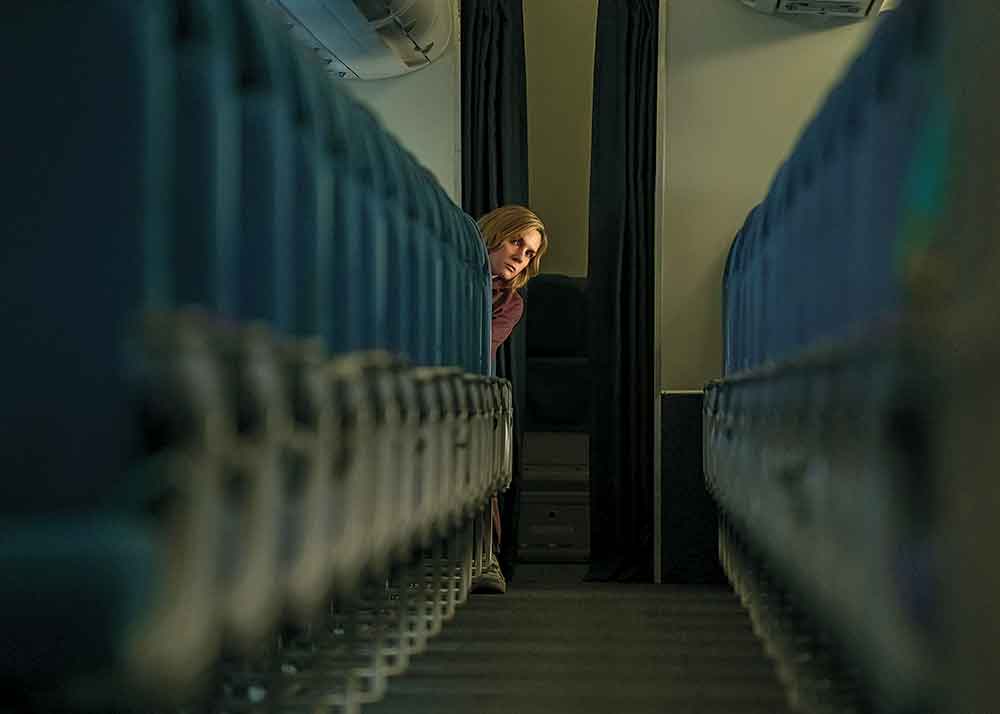
But when literally the entire world is fine with this takeover, why even bother? “I would ask myself that in all the scenes that I had alone, with Carol trying to pick herself up off the floor,” says Seehorn. “Believe me, I might just be watching Golden Girls if I was her and never get past that point. But I would give myself different [reasons], because, ‘It’s right to save humanity,’ is not really playable. That’s too large of a conceptual idea.”
Carol is not just a reluctant hero, but someone who would rather support a mission than spearhead it. “She’s definitely hoping someone else is going to lead the charge and she’s just going to be like, ‘Sure, I can help out with cups and plates, whatever.’ She did not think she was going to have to do this by herself,” says Seehorn. “But we’ve all been there. You keep volunteering slightly and then suddenly you’re the one doing it. Or, you’re the one screaming ‘The barn is on fire!’ and everyone else is like, ‘I think it’s fine.’ The comedy that Vince puts in it, that is born out of human observation, was so much fun to weave it into these very dark spaces.”

The idea of a delightful adversary had been percolating inside Gilligan for almost a decade, starting around the time he began to embark on Better Call Saul. “I’d walk around the neighbourhood near our office building in Burbank, California, and daydream about this guy who everybody was nice to,” he says. “Everybody just loved him. Everybody would do anything in the world for him. I found that pleasing to think about, and then I started to think, maybe this is a story.” Once he realized Seehorn’s versatility, the idea truly started to take shape. “She was a wonderful revelation to me,” he says. “I thought, ‘Man, she’s good.’ She plays all the drama, but then we give her a chance to do some humour and dummy than I am, I didn’t know we hired someone who could be so funny. I started to think, with my next show, let’s let it have a female protagonist. And, indeed, I wrote this for her.”
There may be little question about what the Emmy-nominated actress can pull off in Gilligan’s eyes, but Seehorn knew she was about to be challenged professionally, from the minute she received the first script. “I was like, ‘This is bananas,’ but in the best way,” she says. “You could see Vince playing with these tropes, like it’s a zombie apocalyptic thing, but the zombies are nice. What does that mean? And, also, the tone shifts — how oddly funny it is while being devastating. So, I got really, really excited-slash-petrified. This was going to be really challenging as an actor.”
Being able to sit with the first few episodes during the writers’ strike allowed Seehorn to fully ingest her character. “It ended up being a godsend, because of how many scenes I’m in,” she says. After that, Seehorn “went on the journey very similar to what you would as a viewer,” she says. “I did not see what was coming. But it never feels like shock for shock’s sake. It is just that Vince’s assumption of the audience’s intelligence is so present all the time that you don’t always understand, you just feel like he’s helming the ship in a way that you want to go with.”
Gilligan insists the show has no political axe to grind, but in a world divided he hopes Pluribus will reignite our ability to debate with kindness. “In the writers’ room, early on, we had two writers arguing in front of me about the world of Pluribus. One of them said, ‘There’s a lot to love about this.’ And the other one said, ‘Are you kidding? This would be a nightmare.’ And they both are smart people who could argue their points very coherently. They were both right and they were both wrong,” he says. “But see, the world is always arguing over things. We’ve got to relearn how to disagree with each other and to do it with respect. Maybe Pluribus can help with that. Probably not — I’m being a little grandiose in my thinking — but boy, wouldn’t that be nice?”
Pluribus, streaming Friday, November 8, on Apple TV