


In season three of the sprawling sci-fi epic, humanity’s long-prophesied Dark Age is upon us, at the hands of a terrifying new villain
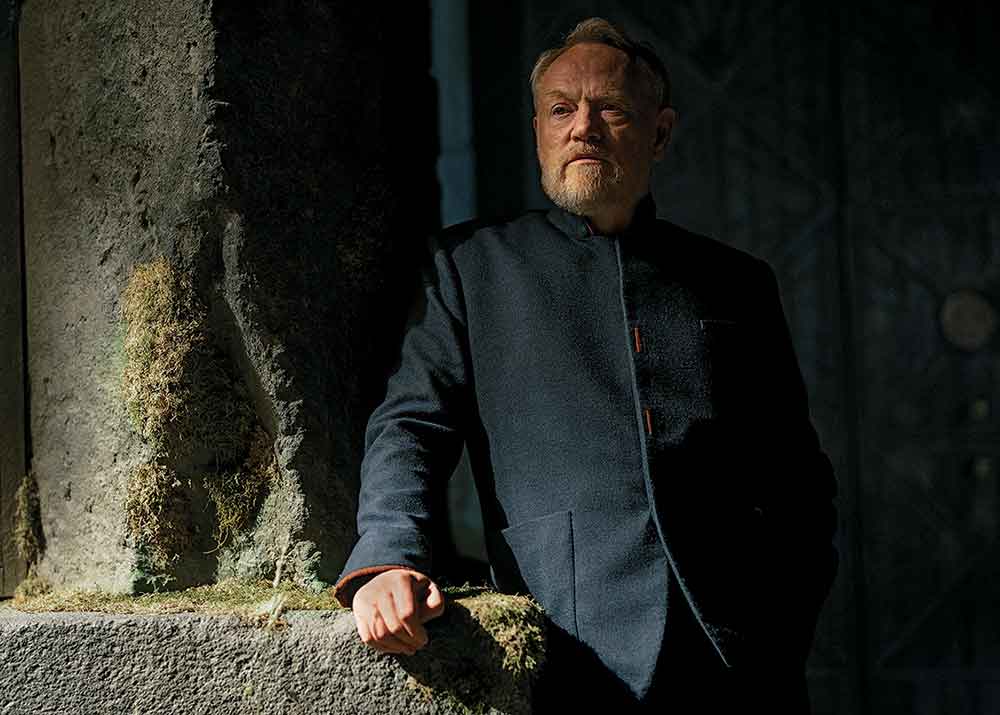
Season three of ambitious science fiction series Foundation, based on Isaac Asimov’s expansive world, presents a dark timeline. The collapse of the entire Empire — which mathematician Hari Seldon (Jared Harris) has been predicting since the first episode of the sweeping epic — is finally imminent, and whether one has accepted the prophecy, like brilliant young mathematician Gaal Dornick (Lou Llobell), or dismissed it like the Emperors of the Galaxy — Brother Day (Lee Pace), Brother Dawn (Cassian Bilton) and Brother Dusk (Terrence Mann) — the end is nigh. How that end is met is what drives the next part of the saga. “Hari has a mathematical plan that can somehow see mankind through that darkness,” says Pace. “And we’re about to walk through that door.”
As previewed in Gaal’s premonition last season, the Dark Ages are brought on by a telepathic mutant that fans of Asimov’s source material have been anxiously awaiting. “The Mule is a personification of chaos,” explains Pace. “He has an ability to mess with people’s minds, get inside their head and make them do things that is not in their best interest.” He arrives to Foundation in the shape of Danish Game of Thrones actor Pilou Asbæk, who is tasked with grounding the series’ Big Bad with at least some shred of humanity. “He is a little bit Shakespearean, if you understand what I mean. A little bit over the top,” says Asbæk. “But my interpretation of the Mule is made in a collaboration with [series creator David S. Goyer], the writers, the directors and all my colleagues. Every single episode I try to create a different side to the Mule, and if you go through all the episodes, you’ll understand why I’m doing all the things I’m doing.”

Tasked with stopping the Mule from completing his mission is Gaal, who, after 152 years of intermittent cryo-sleep, finally is considered a peer to her mentor, Hari. “He respects her as much as she respects him and he is giving her space to become the leader and take his place,” says Llobell. “It gives her the confidence that she needs.” Nevertheless, rising to the challenge is something that unnerves the still-young mathematician. “She and Hari have a plan to get everyone ready and prepared for when the time comes, but it still is a shock,” the actress explains. “It’s the moment of truth and a bit overwhelming for her.”
The prophecy is also a conundrum for the Empire’s robotic handler Demerzel (Laura Birn), for whom the end of humanity may not spell an end to her. “She’s seen it all — she’s lived for 25,000 years — but she understands that we are on the verge of something different this time,” says Birn. “For her, there’s the responsibility that she carries of the dynasty and humanity at a whole. And then there are the existential questions of what happens to her. She’s the last one of her species. What happens if the human species is destroyed? Is there possibility of a freedom? Is that something she wants or is it something that she needs to fight against? It’s the combination of making the right decisions and suddenly understanding that maybe every decision is destructive.”
After centuries of leading his people with an iron fist and a healthy dose of megalomania, the character that has suddenly checked out from reality and responsibility is Brother Day. “He’s pretty certain that he has no control in the galaxy. There’s this robot who’s puppeting him around, that he wants to avoid because he’s sick of it,” says Pace. “He just wants to enjoy his garden, get stoned, play with his ferret and hang out with his girlfriend in the sun. I mean, I get it.” This leaves more room for his cloned brothers, Dusk and Dawn, to finally meet the moment. “With the Cleons, there’s always this expectation that everything will be OK because they have so much power,” says Bilton. “That power is tested more than ever because it’s not power of brute force, it’s power of the mind that really disrupts their plans. From the minute you meet the Cleons this season, particularly Dusk and Dawn, as much as they are presenting this front of strength, I think they’re s***ing it.”
While there are many players on this complicated chessboard, what Asimov ultimately wanted to convey with his writing was quite simple. “Foundation is about our individual relationship to power and how ultimate power in the hands of one person corrupts,” says Harris. To Pace, the series may draw on fantastical elements, but abstract fantasy it is not. “One thing I love about speculative fiction like this is that it can take something that we are dealing with in our own time and examine it in a less serious way,” he says. “Although we don’t have any mutants of chaos roaming around Earth right now, there are people who behave that way. What draws us, the makers, to this is that we are telling a story about here and now.”
Foundation, streaming Friday, August 1 on Apple TV+