


Director Alfonso Cuarón and star Cate Blanchett come to TV for this uniquely mind-blowing thriller about an investigative journalist forced to confront her own secrets when she receives a mysterious novel that seems to be based on her life
Whether consciously or not, fans of film and television are already familiar with the use of “disclaimers.” Often presented as a small blurb of text on screen at the beginning of a movie or the start of an episode, disclaimers signal the validity of the story about to be told.
While the phrase “based on a true story” is a disclaimer in its own right, a denial of culpability such as “any resemblance to persons living or dead is purely coincidental” is more in line with the word’s definition as a tool for legal protection. However, in the case of a new mystery series bearing the title Disclaimer, the press release flips the script and subversively doubles down on its claims with: “Any resemblance to persons living or dead is not a coincidence.”
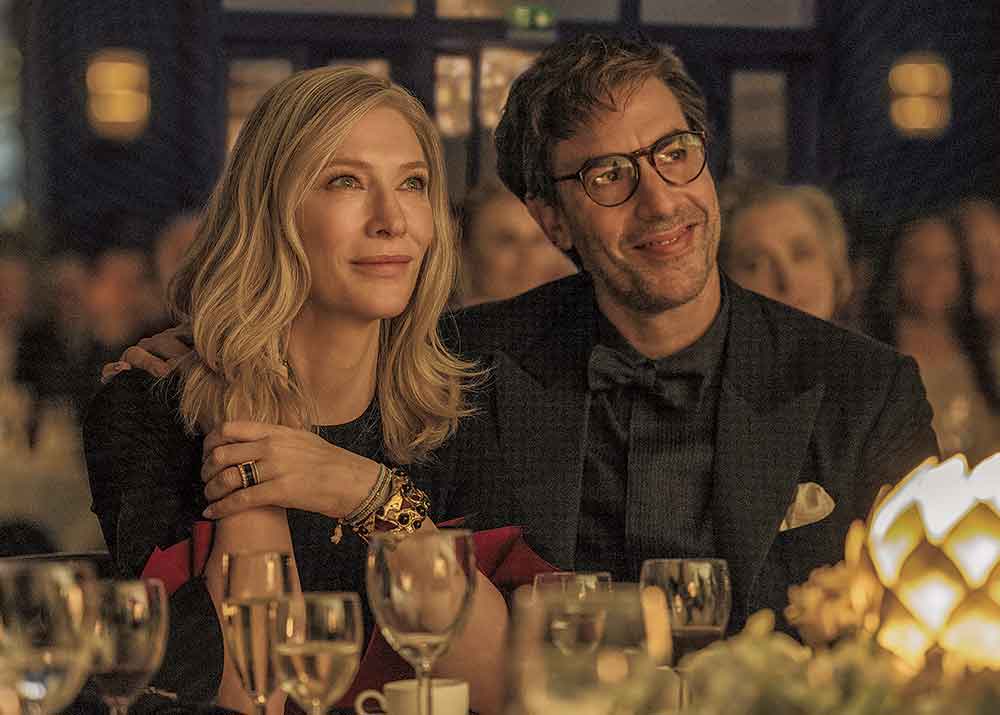
Based on the 2015 novel of the same name by English author Renée Knight, Disclaimer stars two-time Oscar-winner Cate Blanchett as Catherine Ravenscroft, a journalist whose life is turned upside down one day by the appearance of a peculiar novel on her bedside table. Upon opening the book, Catherine comes to realize that she — a woman who has spent her entire career calling out the transgressions of others — is the main subject of the story and that the contents are far from flattering.
With this damning creation now in her possession, Catherine “races to uncover the writer’s true identity” while being “forced to confront her past before it destroys both her own life and her relationships with her husband, Robert (Sacha Baron Cohen), and their son, Nicholas (Kodi Smit-McPhee).”
Described as a psychological thriller, the limited series is divided into seven episodes — to be viewed as chapters within the book — all of which are woven together to form an “overtly narrative” tapestry, according to five-time Oscar-winning filmmaker Alfonso Cuarón, an artist who is far more accustomed to working on the big screen.
“In television, you go A, B, C, D,” the writer-director told Vanity Fair while promoting the show. “In film, you find a way to go from A to D directly. Here it was about experimenting with something different. I have never done something so overtly narrative.”

Cuarón, whose big-screen credits include Roma, Gravity, Children of Men and Harry Potter and the Prisoner of Azkaban, marks yet another prestige filmmaker drawn to TV by the creative freedom and long-form possibilities. Yet somewhat surprisingly — or perhaps not to anyone familiar with his style — the Mexican auteur has explicitly stated that, even though he’s working in a new medium here, he’s not interested in adjusting his storytelling style. Instead, he prefers to shoot series as if they were lengthy films.
“I don’t know how to do TV,” Cuarón mused in that same Vanity Fair interview, “and I don’t think that at this stage I want to really learn.”
On that note, he says, “the shoot was very, very long,” which allowed him the attention to tone and detail for which he is well known.
The cast of Disclaimer also includes big names like Kevin Kline and The Crown’s Lesley Manville, as well as budding actors Louis Partridge (Pistol), Adam Szabo (Slow Horses), Leila George (Animal Kingdom) and South Korean supermodel-turned-actress Hoyeon (Squid Game). CNN chief international anchor and renowned journalist Christiane Amanpour also appears in the series as herself.
Present in voice only is another familiar actress: Game of Thrones’ Indira Varma. Providing much of the narration for the series, Varma serves as a grounding presence, tying the seven chapters of the series together into a cohesive story. Her narration offsets other voiceovers and perspectives within the show, sparking added suspense and distrust among characters.
“By working with those voices, you dig further inside the characters,” Cuarón explained. “You can dig further inside fears, inside anxieties, inside their past, their guilt, their misgivings.”
The creator was also excited to point out that he had the chance to use the second-person perspective in Disclaimer, which is something tricky to achieve due to its unique, accusatory nature.
“In Spanish and in French, the second tense is called ‘accusativo,’ ” he remarked. “It is accusing. That was part of the reason for creating that voice in the second-person.”
Disclaimer, begins streaming Friday, October 11 on Apple TV+