


The mystery deepens in the third season of sci-fi thriller Silo
To expect easy answers from Silo is to not know the post-apocalyptic drama. In its third and second-to-last season, the mystery of why tens of thousands of people live in bunkers extending 144 levels below ground remains unsolved. But as we get closer to the end, series creator Graham Yost promises light at the end of the tunnel, quite literally. “We all wanted to go out a little,” he says. “We want the audience to be able to see some sky.”
The sky appears in a pre-silo world, where humanity still lives above ground. At the end of the second season, viewers were briefly introduced to United States congressman Daniel Keene (Ashley Zukerman) and investigative journalist Helen Drew (Jessica Henwick) in the before times. That storyline, which will provide answers for how we ended up in the silos, picks back up in season three, where in a not-so-distant future to our present, a retaliatory U.S. mission in Iran has piqued Helen’s interest. “Helen knows that there is something afoot here and the powers that be are lying,” says Henwick.
She believes that Daniel, whose fighter pilot sister Charlotte (Jessica Brown Findlay) is part of said mission, can help crack the case for the good of the public. “Daniel does believe in service, and I think he starts the series knowing that he lives in a compromised world but believing that the system will be able to self-correct itself,” says Zuckerman. “Over the course of the series that erodes.” Much of that has to do with the consequences of the mission, which leads to his sister losing her memory. “Not only does he have to live with the tragedy of essentially losing his sister, he has to actually figure out what he wants from life,” says Zuckerman. “We all know that we live in a compromised world and how different characters deal with that is the question of the show.”

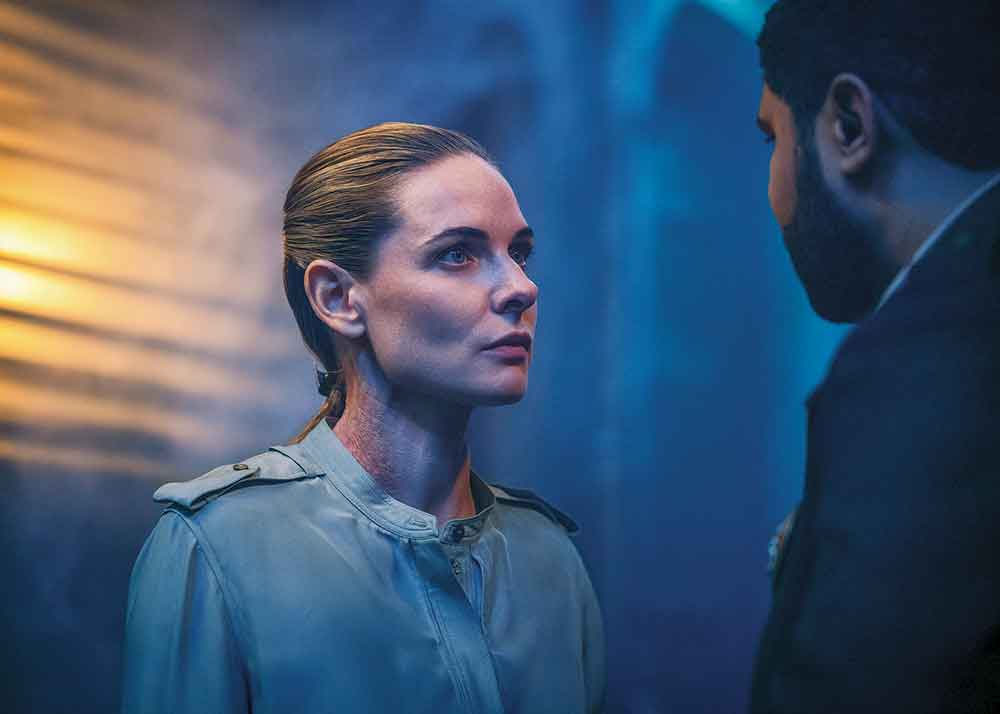
Charlotte’s memory loss is mirrored in Silo 18, where Juliette (Rebecca Ferguson) is now mayor, but without any recollection of what happened after her return from Silo 17 — nor the fire that allegedly took the life of Bernard Holland (Tim Robbins), head of the IT Department. “There’s a forced mayorship that she has to live through and there’s information about who she was. But [her] truth doesn’t feel right compared to the information being given to her,” says Ferguson.
Lack of tenacity has never been the former mechanic’s problem, though. “You can take her memory away, but you can’t take the questioning away. I think that’s why we love her. Juliette is a woman of action. She asks a question. If she doesn’t get an answer, she will come at it from another angle. She will activate the help she needs,” says Ferguson.
Additionally, her body is telling her something, whereas the answers she is given don’t reflect that. “The burns, there’s a story behind them, and she wants to go to the root of all that,” says Ferguson. “There’s a repetition of information that doesn’t make sense. Juliette’s cause is that constant, ‘Why, why, why? Your answer is not correct. Why?’ There’s an unsettled feeling in Juliette. There’s something off and she doesn’t know what it is. She doesn’t really know entirely who she is. But something happens at the end of the first episode where Juliette gets a message and if she wasn’t Juliette, she’d just go, “Eh, that doesn’t apply to me.” But that’s one of the core principles [of identity] — if you lose your memory, you’re either a kind person or not a kind person. Juliette is always an inquisitive person.”
The information being fed to her is predominantly coming from Camille Sims (Alexandria Riley) who has taken over as head of IT. “Juliette’s the problem for Camille, or she feels she is,” says Riley. “There’s a lot of manipulation going on there, a lot of puppetry, because this is the person standing between their survival and God knows what else.” Camille’s unwavering commitment to the Legacy — a computer demanding she suppress Juliette’s memories with drugs — is also coming between Camille and her husband Robert (Common), the head of security for Judicial in the silo. “Robert was always bouncing his thoughts and fears off of Camille, but once Camille is given the position that Robert wanted, and can’t share anything with him, the dynamic has shifted,” says Common. “Her idea of saving the silo is now going in the opposite direction of what Robert believes to be the right way. Robert is seeing that the powers that be are not what he thought they were. So, Robert’s dealing with his beliefs being shattered and he doesn’t have a wife that’s present for him. It’s a lot to deal with.”
Silo continues to build its central mystery, but getting to a point where real answers are being dispensed has been a real thrill for those making the series. “It’s fantastic,” enthuses Ferguson. “From our perspective as actors, it puts our character in another equilibrium. There was another baseline we could work off of. That was really fun.” Yet with 10 episodes filmed out of order, even great answers sometimes need to be questioned. “We had to constantly go back to Graham and go, ‘Whoa, wait, should we give this away?’” says Ferguson.
Although Hugh Howey’s books are leading the way, Yost is grateful for all the input he gets from Team Silo as the show nears its end. “Harriet Walters noticed something in a scene that she wasn’t in. She said, ‘Actually, this doesn’t make sense because these two characters already know this.’ And I realized, ‘Oh, I wrote that scene and I screwed up.’ And then we got a note from the Japanese translation team and they said, ‘There’s this visual effect you have. It doesn’t really match what’s in the script.’ And we’re like, “Oh s***, you’re right,” says Yost. “Everyone is trying to defend the integrity of the story. I’m sure at the end of the series, people could write a long paper on all the things we didn’t answer or screwed up or didn’t match up, but we did our best.”
Silo, streaming on Fridays on Apple TV