


Anne Rice’s iconic undead antihero tastes rock stardom in The Vampire Lestat
Diving into The Vampire Lestat, the third season of Interview With the Vampire finds manipulative and sexy vampire Lestat de Lioncourt (Sam Reid) now a bona fide rock star. As he tours North America with his band, the tone of the usually dark drama seems lighter than its previous iteration as Lestat experiences the perks of fame and fortune. But, as showrunner Rolin Jones informs viewers, a rose by any other name still smells the same. “You’re being seduced,” he teases. “It’s going to get about as dark as we’ve ever gone.”
Even if the onscreen action currently feels more playful, that is by deceptive design. “It is structured around how Lestat wants to tell his story,” says Jones. “I think he comes in very confident, thinking he can be glib and fun and keep it at bay. As he gets deeper and deeper into recording [his version of the story] and things are coming up, it begins to change how the story is being told, and how you’ll feel about it. It’s a part of an emotional landscape.”
The journey of the third season is, in part, framed around the contents of 111 albums, Lestat’s life’s work until catastrophes — that we are yet unaware of — ensue. But, as can be expected, some of those recordings — titled The Failures — have more substance than others. “We, in the writers’ room considered some of those albums Lestat waking up one day and pulling out a Danielle Steel novel and just reading it,” says Jones. “Some of it is [meaningful] and some of it you can just imagine he’s screwing around a little bit.”

Reid imagines Lestat wants his audience to have fun, more than anything. “He doesn’t want to engage in any sort of trauma porn or any sort of capacity in which he may have been interpreted, in the past,” he says. “That’s from the books, and I think Rolin and the team have done an amazing job of replicating that experience . . . where you feel like you’ve gone into a much more irreverent, playful space, but the darkness creeps in very slowly and takes over. He can’t escape it, either. It’s like he’s constantly crawling out of the grave while it’s being shoveled full of dirt.”
Other than his creative ambitions resulting in the documentation of his chaotic rock star life, cynical journalist Daniel Molloy, played by Eric Bogosian, is also willing to listen to Lestat’s defiant side of the story, after publishing Louis de Pointe du Lac’s (Jacob Anderson) version of events. This, says Bogosian, fundamentally changes the structure of the show. “This season, I’m not interviewing Louis anymore which had a step-by-step solve-the-mystery thing to it,” says Bogosian. “Now, Daniel is interviewing Lestat, who is doing everything he can to throw things in the way of the interview, and it becomes a much more headbanging experience.”
What also makes the interview experience much different from the first is that, after completing his book, Daniel was turned into a vampire by Armand (Assad Zaman). “I’d say that, even if he wasn’t good at life, he’s a very rational guy and he’s led a rational life,” says Bogosian. “And now, he’s in this very chaotic vampiric universe where normal logic does not apply. It’s confusing and challenging.”
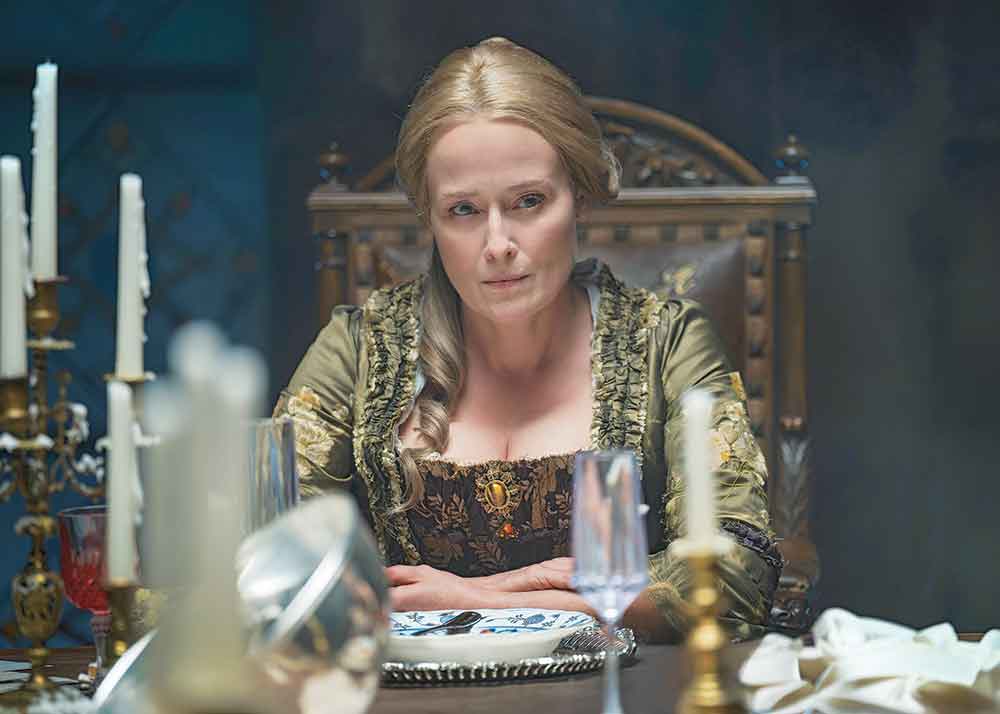
Another shock awaits Daniel with the arrival of Gabriella de Lioncourt, whose intimate relationship with the younger undead Lioncourt is surprising to anyone unfamiliar with the Anne Rice books. Played by Jennifer Ehle, perhaps still best known for her portrayal of Elizabeth Bennet in the BBC adaptation of Pride and Prejudice, this iteration of Gabriella is also very much seen through the eyes of an occasionally unreliable narrator. “What’s important is the story that Lestat’s telling,” says Ehle. “I think you get a sense of who she is when you see the entire thing. But I think I was just realizing his vision of her. Who she is [in her own mind], is kind of not important for the storytelling.”
Jones adds that, while Gabriella’s unfolding as a character appears one way to readers of the books, he and the writers have used the entire oeuvre to tell this version of the story. “There are a lot of decisions we made about Gabriella based on some later books,” he says. “Anne gave us all these books and we’re looking at them all the time to try to take relevant material and put it here and now.”
As the narrative circles less and less around mere mortals, Anderson and Reid reflect on the biggest difference between playing the human versions of their characters, and them as vampires. “Part of what is so inviting about Anne Rice’s vampires is that they’re the most human once they become vampires,” says Anderson. “These are characters that in their human existence didn’t ever quite do the processing, and now they have to live with themselves forever.”
For Reid, this has been a real opportunity to amplify the issues that plagued Lestat as a human. “There’s a quote from one of the books where [Rice] does say, ‘We never really change over time. We just become more of what we really are,’” says Reid. “When you add on an immortal layer, all of the humanity and the issues that drove their life to certain points, are amplified . . . The vampire gives us an artifice to explore humanity in this very large operatic scale.”
To that end, creating Lestat’s larger-than-life onstage persona had Reid looking to his character’s 18th-century performance roots, as well as more recent musical legends. “His onstage persona is the French iteration of the commedia dell’arte, because that’s where he built his stage presence,” says Reid. “I did look at David Bowie, particularly at the Cracked Actor recordings of those live concerts — mostly to try and always remind myself that he’s not human, he’s supernatural. I wanted to make sure we maintain that he is a kind of other thing, which I thought David Bowie did extraordinarily. But, in terms of his stage presence, I wanted to make sure it felt theatrical, because he’s still performing the idea of a rock star — at least at the beginning. Then, as the show progresses, the performance starts to disappear.”
The Vampire Lestat airs Sundays on AMC